
MeetFuture and the Case for Stateless AI
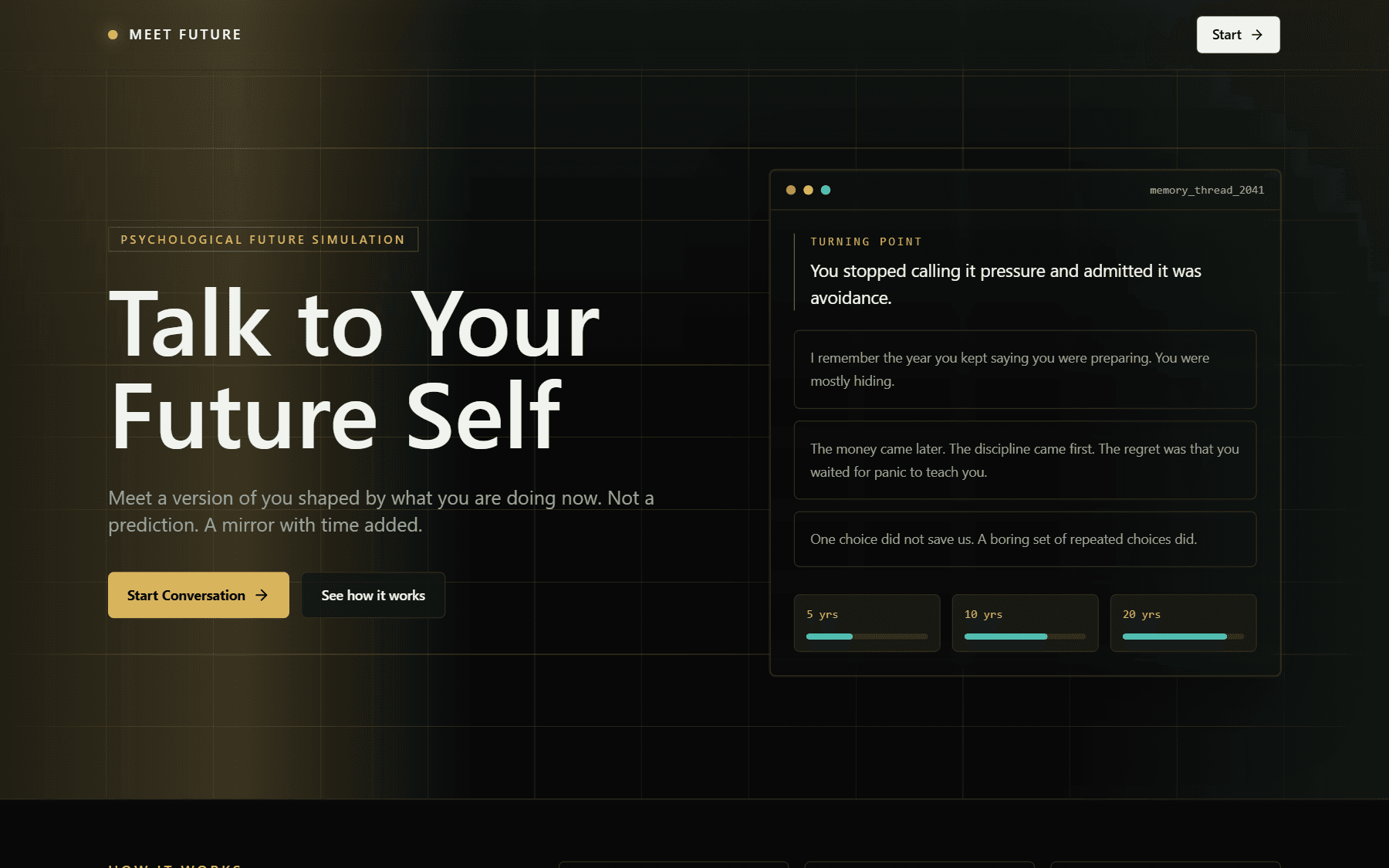
MeetFuture's public promise is unusually specific: answer a set of deep personal questions, generate one possible future-self timeline, then chat with that simulated future self. The live site says as much, and the public repo adds one important implementation detail: the app is stateless.
That choice changes the shape of the product.
Instead of building a long-running memory system, the published app focuses on a single guided session. The repo README says there is no database and no persistence. The route tree backs that up with public endpoints for future generation and follow-up chat, plus modules for prompts, questions, and validation.
From a product perspective, statelessness is not just a technical shortcut. It is also a trust and scope decision:
| Public trait | What it changes | | --- | --- | | No persistence | Less personal history to store or secure | | Questionnaire first | The generation has structured input instead of vague prompting | | Separate generate and chat routes | The product can treat creation and conversation as distinct stages |
The repo package also makes the stack legible: Next.js 15, React 19, and OpenAI. That is enough public evidence to understand the product loop without pretending we know private internals that were never published.
What makes MeetFuture strong portfolio material is the restraint. It does not try to be a generic AI chatbot. It is a shaped experience with a clear beginning, a clear transition into chat, and a delivery model that keeps the public story consistent with the code.
For teams building AI products, that is a useful reminder: the most convincing public proof is often not a bigger feature list. It is a tighter contract between product promise, technical shape, and what a visitor can verify for themselves.